


Go to bat for us.
Join our roster.
Own a piece of history.
Join our roster.
Own a piece of history.
Go to bat for us.
Join our roster.
Own a piece of history.
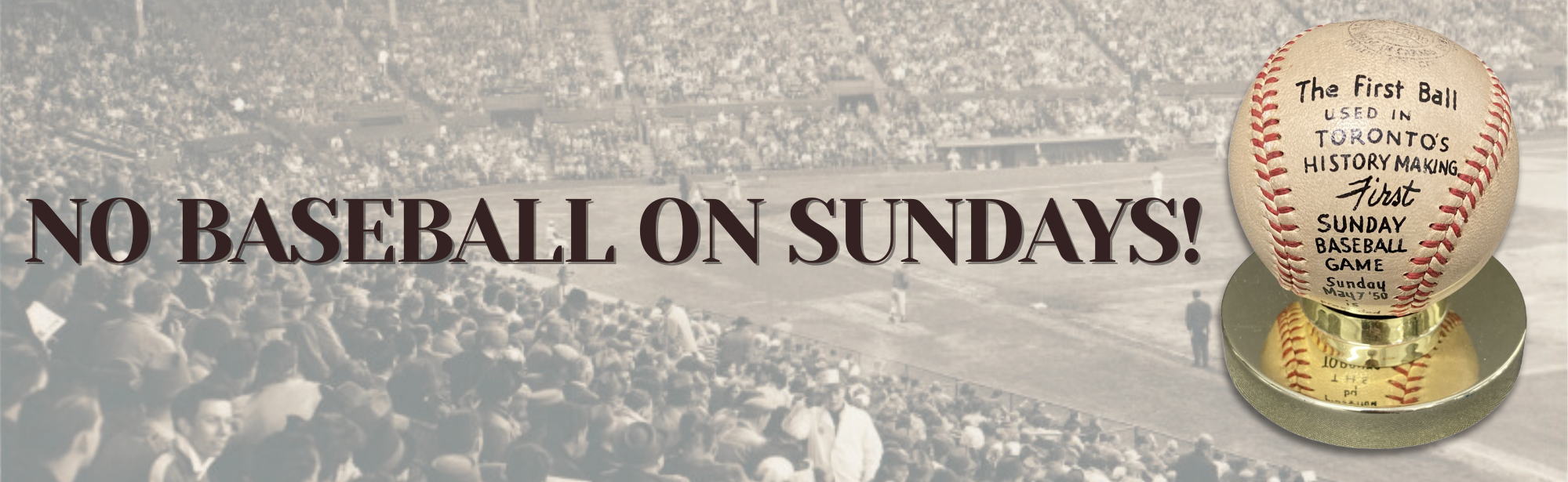
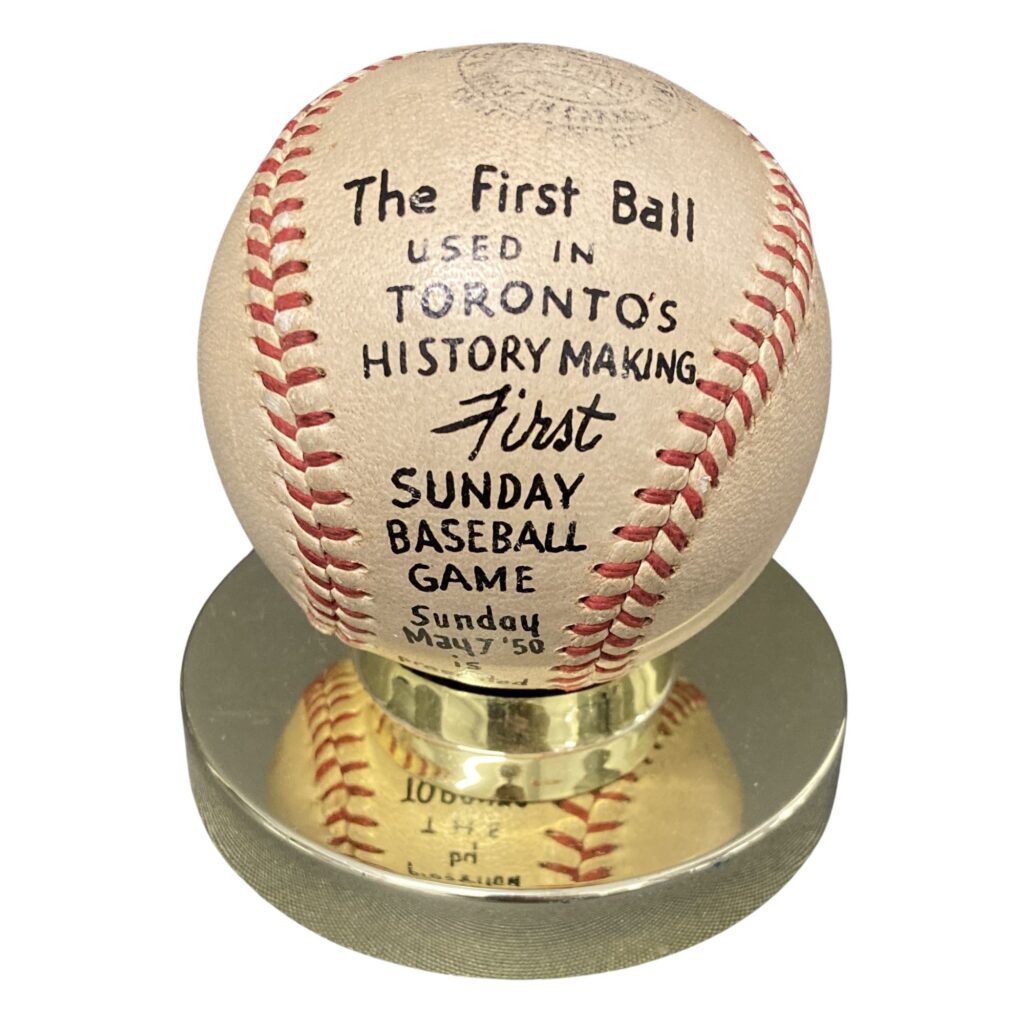
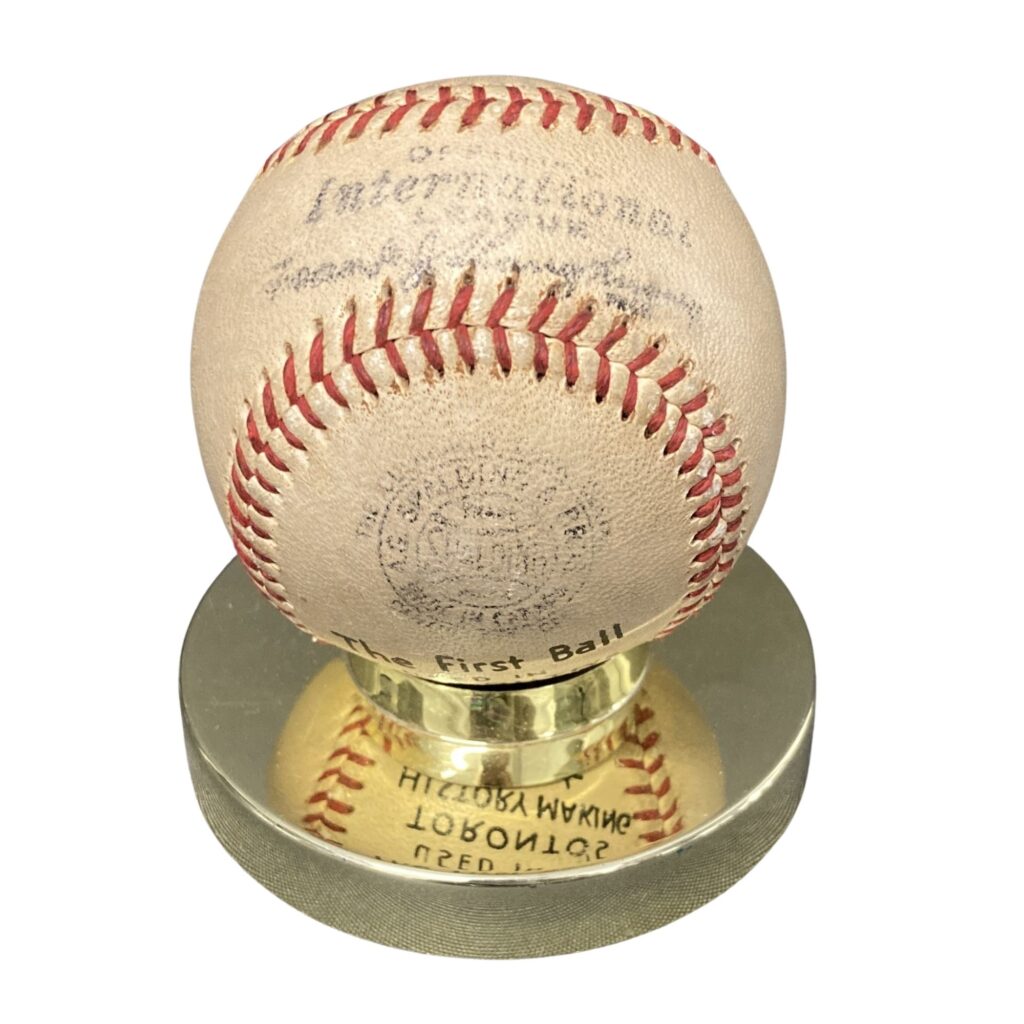
On May 7, 1950, the Toronto Maple Leafs of the International League took on the Jersey City Little Giants in a history-making baseball game. With league commissioner, Frank Shaughnessy in attendance, and local politicians tossing out the first pitch, a sizeable crowd turned up at Maple Leaf stadium to watch the first Sunday baseball game in Toronto’s history. Today it’s impossible to imagine squeezing in a complete baseball season without Sunday games, especially for an MLB team, but this was reality prior to 1950, and it all had to do with Blue Laws.
What are Blue Laws?
Blue Laws, also known as Sunday Laws, are those which prohibit certain activities on Sundays or religious holidays, and Canada’s Blue Laws are older than the country itself! In 1845, Upper Canada passed “An Act to Prevent the Profanation of the Lord’s Day, commonly called Sunday, in Upper Canada”. The purpose of the act, in mimicking the Blue Laws already in existence in Europe, was to prevent an individual from doing anything on the Lord’s Day except attending church and spending the day in religious observance. This act made it illegal to operate a business on a Sunday, to go to a public house, to purchase or sell alcohol, to brawl or curse in the streets, or to hunt, swim or fish. Among those activities that were barred under the act, the wording specifically describes, “nor shall it be lawful for any person or persons to play at skittles, ball, foot-ball, racket, or any other noisy game” (“An Act to prevent the Profanation of the Lord’s Day, commonly called Sunday, in Upper Canada”, March 29, 1845, retrieved from the British North America Legislative Database, University of New Brunswick). The only non-religious activities allowed were those considered essential, including delivering the mail, selling medicines, or conducting acts of charity.
From the start, the Blue Laws faced backlash in Canada. Firstly, the laws only accommodated for religions that practice a day of rest on Sundays, and not, for example, faiths whose Sabbath day is Saturday. In addition, individual communities differed on what activities should be outlawed, and enforcement of the laws varied widely across jurisdictions. In many localities, the laws were so strict as to close public parks using padlocks to keep children at bay, and law enforcement was often put in the troubling position of removing children from play and seizing sports equipment. In one article from the Ottawa Daily Citizen in 1876, the reporter writes, “A number of young men who should know better desecrated the Sabbath yesterday by playing ball on the Base Ball Grounds. Constable Gordon got wind of it and put the Sabbath breakers to flight” (Retrieved from todayinottawashistory.wordpress.com).
Eventually, the Upper Canada act was repealed, only to be replaced by the federal “Lord’s Day Act” in 1906. Under the guidance of this new act, which gave municipalities greater control over choosing the activities that were to be restricted, Toronto gained a reputation as a particularly stringent enforcer of Blue Laws, but with equally vocal opponents.
The Lord’s Day Alliance vs. The Sunday Afternoon Sports Committee
Fred Hamilton, who had been a baseball coach in Toronto for many years, working especially with underprivileged youth, was one of Toronto’s primary opponents of the Sunday Laws. After being elected to City Council in 1929, he used his platform to fight for families and youth to be able to play sports on Sundays. In 1938, his efforts finally convinced Toronto city council to stop padlocking the city’s parks in the summer (although people had to bring all of their own equipment to enjoy the parks, and the parks remained locked on Sundays in the winter). Hamilton’s was the first major blow to Toronto’s Blue Laws, but he didn’t stop there. He formed the Sunday Afternoon Sports Committee (SASC) to keep the fight going.
The SASC’s primary opponent was the Lord’s Day Alliance, a formidable group of lobbyists made up of representatives from both Catholic and Protestant denominations. The lobbyists saw their efforts as necessary to save their congregants from the distractions offered by Sunday activities that might keep their flock from church.
As the battle waged on, Toronto continued to evolve, with immigration and a rapidly growing population becoming increasingly less adequately represented by the advocates of the Blue Laws. As the Lord’s Day Alliance fought for the laws to be upheld, an increasing number of Torontonians screamed for change.
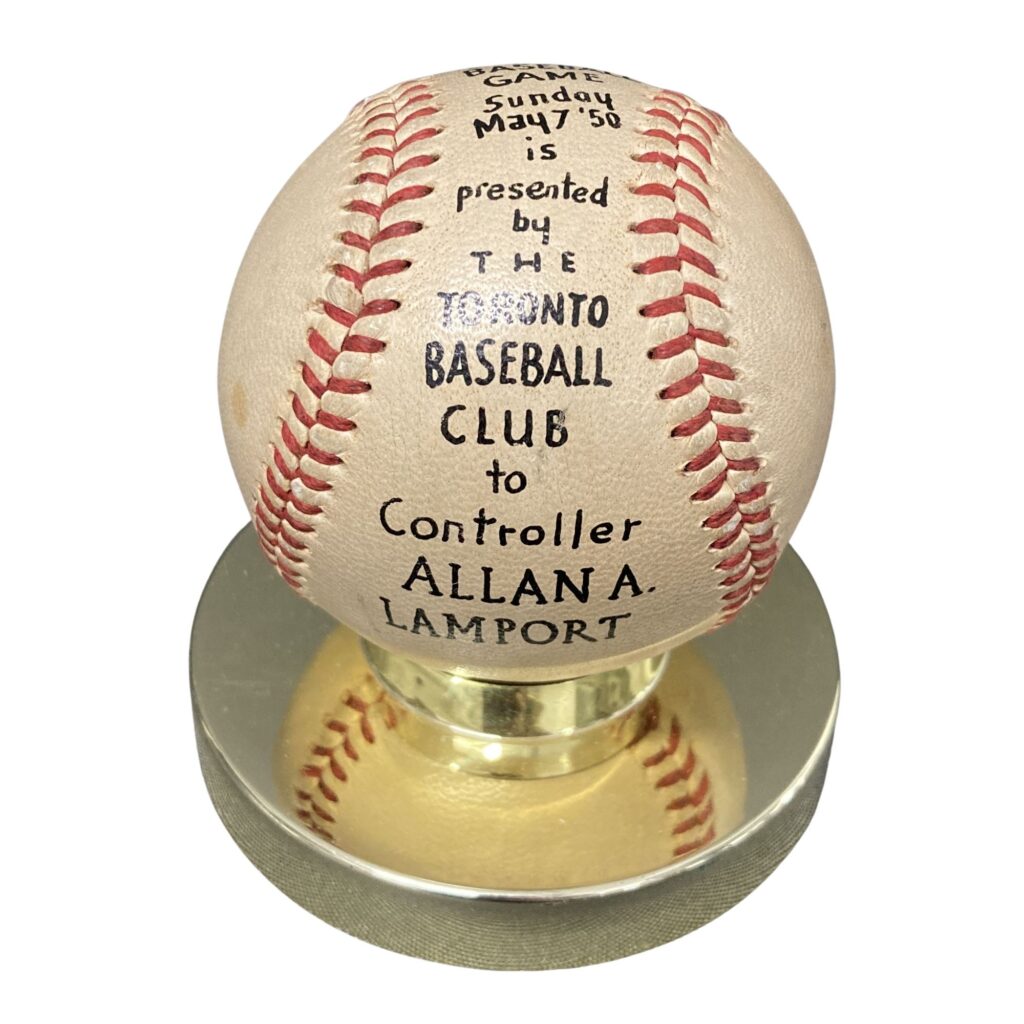
The loudest of those voices throughout the 1940s, joining Fred Hamilton and SASC, was Allan Lamport (pictured), a Liberal Member of Provincial Parliament who was elected as Controller for the City of Toronto in 1949. Lamport was likewise a determined advocate for Sunday activities.
In early 1950, Lamport finally managed to force a plebiscite (a city-wide vote) on the matter of Sunday sports. Although hopeful, SASC was not overly optimistic. However, despite the strength of the lobbyists on the “No” side of the debate, and despite the historically low voter turnout by those on the “Yes” side, the pro-sports on Sunday advocates turned up in droves. The plebiscite garnered a record-setting voter turnout, and the Sunday Afternoon Sports Committee and their allies won the vote by 52%.
Once Ontario passed its own Lord’s Day Act, the plebiscite became official. The act allowed for any sport (with the exception of horse racing) to be held between 1:30pm-6pm on Sundays, and Toronto swiftly passed a by-law making this the official rule within the city. With baseball as a spearhead, change was finally taking place in the City of Toronto, as Sunday sports were at last legal.
On May 7, 1950, Toronto’s first legal Sunday baseball game took place at Maple Leaf Stadium. The two primary champions of Sunday baseball, Fred Hamilton and Allan Lamport were invited to open up the event. Fred Hamilton threw out the game’s ceremonial first pitch, and Allan Lamport received the pitch from the batter’s box, hitting a single. It was through their efforts that the crowd of 17,388 fans were in attendance that day at all.
Despite the fears of the Lord’s Day Alliance, the crowd did not fall into sin, but instead enjoyed a very well-behaved afternoon out with family and friends.
Unfortunately, the ballgame itself had a disappointing ending. In the second game of a double-header, the teams were narrowing in on the pre-established 6pm curfew, but had not yet played the minimum innings for an official game. As one team dragged its feet and made errors to extend the game, the other bunted outs directly at defenders to try to get through the game faster. Commissioner Shaughnessy was furious, dolling out fines, and demanding the second game be replayed. The legacy of Toronto’s first Sunday game was somewhat tainted by the antics, but the importance of the event cannot be denied. The Maple Leafs continued to struggle that season, and with a year of bad weather added to the mix, attendance plummeted. In the end, those Sunday crowds may in fact have saved the Maple Leafs from ruin in 1950.
The Toronto Maple Leafs Schedule from 1950. Sunday games are noted with an asterisk. Before the ruling was confirmed, Commissioner Shaughnessy had two schedules made up for the 1950 season, one with Sunday baseball in Toronto, and one without. This is the version that was published once the act was made official.